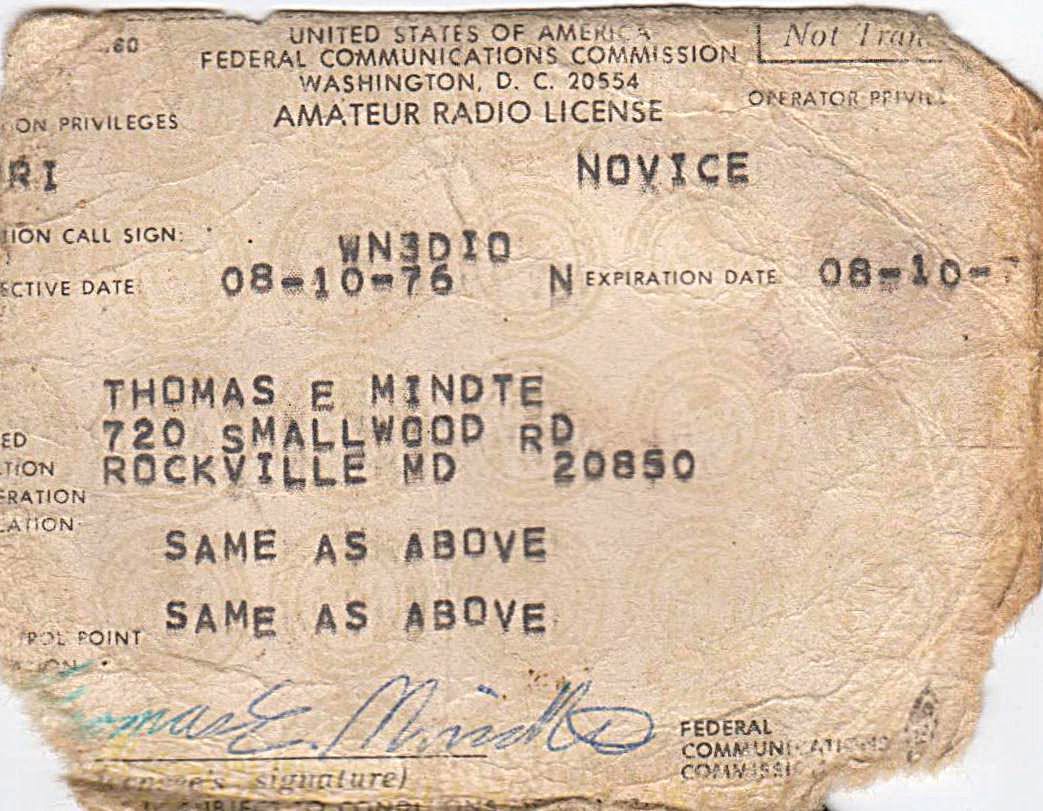
My first Amateur Radio license
7. Table of Contents Previous Next
8/10/26
“Busting Up a Crime Ring”
Fifty years ago today, August 10th, 1976, my Amateur Radio license was issued by the Federal Communications Commission. I’ll tell you a little bit about Amateur Radio, affectionately known as “Ham Radio” and its often-denigrated cousin, CB radio before I get into a little adventure I participated in that involved both.
Marconi’s first transatlantic radio transmission in 1901 sparked (Hams will get this pun) a radio craze, attracting thousands of hobbyists around the world. Before long, those mostly young inventers and tinkerers were building their own “home brew” radio gear that allowed them to communicate with one another over the air by Morse code. By 1909, a list of Amateur Radio stations had been published. The hobby became so widespread that governments stepped in to regulate the radio enthusiasts, as they were interfering with ship-to-shore communications. In the United States, the first Amateur Radio license was issued in 1912 in the wake () of the Titanic disaster. Since then, to obtain a ham radio license you have to pass a test in radio and electronics theory, communications practice, and until recently, the Morse code. In the 1920s as technology improved, Hams began transmitting their voices over the air in addition to Morse code. We are allowed to use up valuable radio frequencies because we often aid government agencies in times of crisis when their communication systems become overwhelmed or they have insufficient personnel to handle the radio traffic that arises during those emergencies. Hams are allowed to communicate on many different radio bands, so world-wide communication is easily accomplished.
Citizens Band (CB) radio is also for radio communications enthusiasts but requires no test and as of 1983, no license. Unlike Ham radio, CB is only used for short-distance communications. CB enthusiasts also aid government agencies in the same way that hams do. Before cell phones, motorists could call in on their CBs to report emergencies.
Naturally, there’s a rivalry between CB and Ham operators, as the former is looked down upon by the latter for reasons stated above. But this story is about a time when Hams and CBers got together to help solve a crime.
In 1980, some teenagers stole eight police radios from the back seats of Montgomery County, Maryland, police cars. The cops had the habit of unclipping the hand-held radios from their belts and tossing them on to the back seats of their cruisers when they were about to occupy the driver’s seat, as the radios of that time were too bulky to stay clipped to the belt while driving. Incredulously, some of these officers left their cars unlocked when they parked them at the local donut shop (this is for real!). The kids would wait outside and snatch the radios. Once the motus operandi was discovered, they started locking up but by then, the eight radios had been stolen.
The young’uns were chit-chatting and bragging about the heists over the police radios, thus disrupting police communications. They were also planning the larger crime of breaking into a radio store, using CB radio and Morse code to talk to one another. They spoke the dits and dahs of the code over the CB. That’s why the County sought the help of both Hams and CBers. Members of the CB organization installed their radios in police vehicles and rode in the passenger seats, while I and others from the Ham club rode in the back, where the radios sat before they were stolen (ha ha), to decipher the code.
One night, after we had been cruising around for a couple of hours, trying to find the places where the CB signals were strongest, the kids began debating amongst themselves about which store to hit, Montgomery Radio, a CB store, or Scanner City, which sold radios designed for hobbyists who liked to monitor police communications. So, one would say, “Dah dah -- dit dah dit or dit dit dit -- dah dit dah dit,” (MR or SC). They decided on Scanner City. The police vehicle that I was riding in was an undercover tricked-out van that had been confiscated during a drug deal, so ours was the first responder. As we approached Scanner City, our cop told my CB partner, who became a long-time friend after that night, and I, “Stay in this van no matter what happens.” While we were waiting for backup units to arrive in the area, the thieves arrived ahead of schedule and started to disable the store’s outside alarm bell. All of a sudden, our policeman grabbed his shotgun and dashed across the street. The kids saw him, scattered, and our man chose one boy to chase. Peg (my CB friend) and I saw him toss the loaded shotgun into the back of a conveniently parked pickup truck as he ran, probably because the weight of the gun slowed him down. They all disappeared around the corner, and we obediently sat in the van and waited - and waited.
After a couple of hours, Peg used the CB radio to call her friends, who called back and said the police were on the way to rescue us. Upon arriving at the station, we found out that they had rounded up the culprits as each tried to sneak back to their car, one by one. I drove by the scene of the crime the next morning to see if the shotgun was still in the pickup, but the truck wasn’t there. So, maybe its driver got arrested for carrying a weapon as he drove around without knowing the gun was there (or maybe not). Our escapade made the headline in the Montgomery County Journal. Peg is in the photo with all the gear that was confiscated from the kids.
Photos:
Tom Mindte
August 10, 2026
My first Amateur Radio license
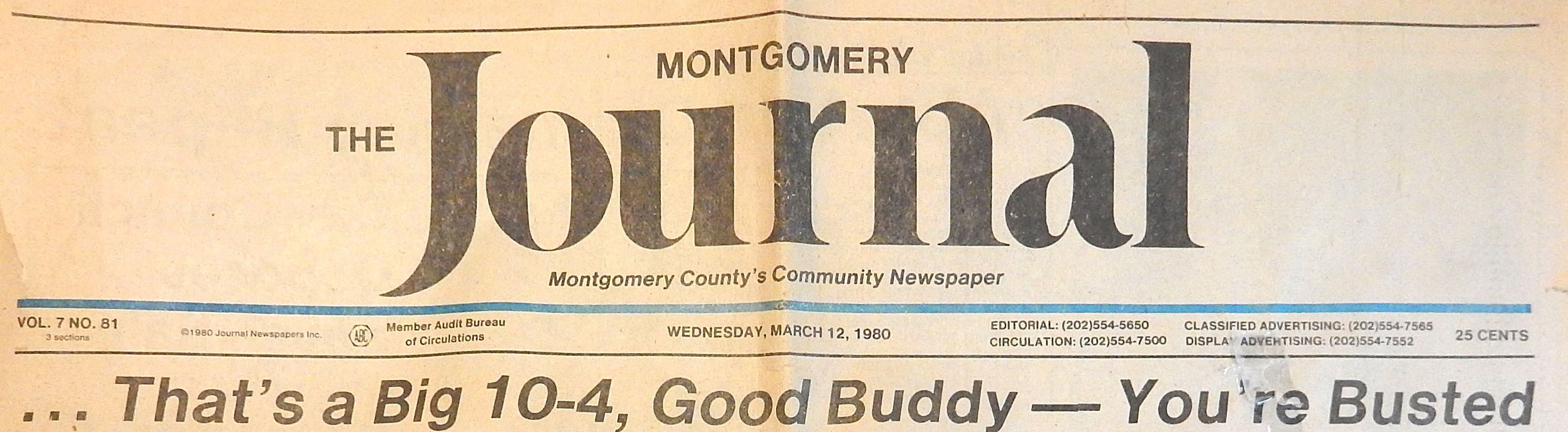
Headline from Montgomery County Journal
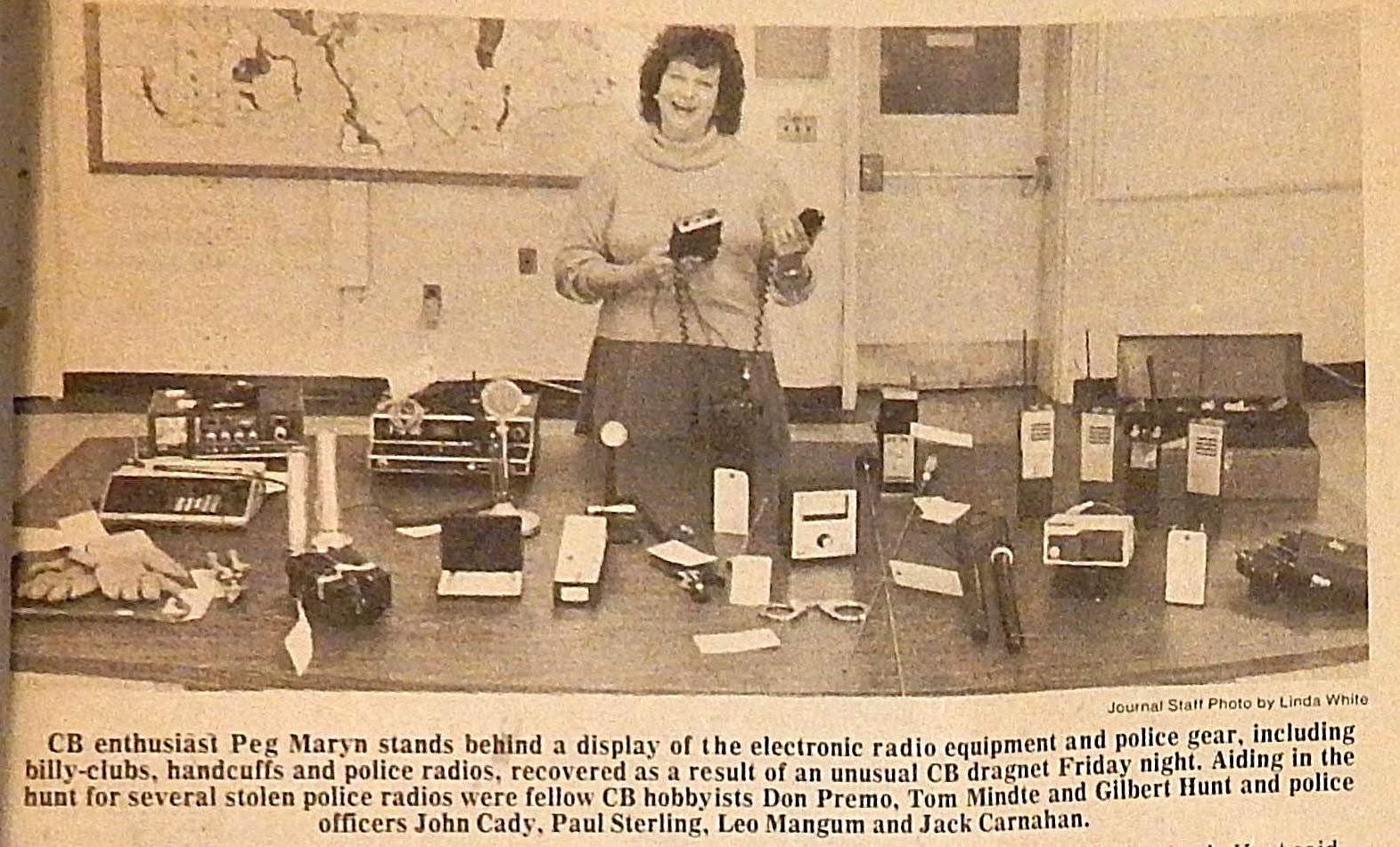
Peg Maryn with the loot.