
“Cathedral” by Jackson Pollock
28. Table of Contents Previous Next
9/18/26
“And Last but Not Least, Jackson Pollock”
The world’s first radio engineering school, Capitol Radio Engineering Institute, began as a correspondence school in 1927. Over the years it has expanded, adding a residency program and dormitories and is now Capitol Technological University. When I landed there to start my college education, the school had recently enhanced its catalog of courses to include non-technical subjects so it could become an accredited institution and bestow legitimate BS and MS degrees. They added history, English, psychology, sociology, and an all-encompassing humanities course that covered art, poetry, and music appreciation to the curriculum. The professors who taught the classes that were devoid of electronics, math, and science were faced with classrooms full of nerds, me included, who didn’t really want to be there. We wanted to be designing microchips, making robots, writing computer code – you get the picture. Those instructors knew they were facing hostile audiences, so they made their courses as difficult as they could, for spite. At least it seemed that way to me.
During the art appreciation phase of the catch-all humanities course, one of the assignments was to stand before the class and describe a famous painting using the terminology of art critics - terms like tone, composition, texture, mood, atmosphere, form, and shape. Well, the last one was easy anyway – rectangular for most of them. Upon entering the classroom, each of us chose a print of a famous work of art, first come first served. I was late that day, so as I walked in, the good old prof said, “And last but not least, Jackson Pollock,” handing me the only print left in the box. My painting looked something like the spin-art we made at the carnival as kids. I took my seat and tried to figure out what I was going to say.
Now, I’ll jump forward thirty years to the twenty-first century.
My band, the Patuxent Partners, played a small run of shows in The Netherlands. On a day off, we did some sightseeing in Amsterdam. One of the sights we saw was the Van Gough Museum, which housed not only Van Goughs, but countless paintings by the other old masters. We musicians tended to spend about twenty or thirty seconds looking at each painting and forming a one or two-word opinion about each. “Cool,” “nice,” “blurry,” “that sucks,” “what’s that?” and so on. After looking at a wall full of Van Gough masterpieces, our merchandise hawker, Eric, said “I don’t blame him for killing himself if he couldn’t paint any better than that.”
On the other hand, the art lovers were staring at each painting for a long time. There were benches in front of some of the major works for the long-term observers. Some of the same people were looking at the same paintings the entire time we were there. I thought - What’s up with that?
Wait a minute! I froze in my tracks and just stood still as a lightbulb went off in my head. One of the staff asked if I was alright but I shook him off as the gears turned in my brain. Finally, the insight became fully formed. - They were looking at art the way we listen to music. As non-artists, we can’t see what they’re seeing, just as non-musicians can’t hear music the way we do. Wow!
------------------------------------
I listen to certain recordings by Bill Monroe, Frank Wakefield, Benny Goodman, Louis Armstrong, Danny Gatton, Dave Macon, Grappelli, and a few others several times a year and each time, I hear something I missed before, even after more than six decades of listening. I once traveled to Nashville with former Blue Grass Boy Lamar Grier, who had Scruggs’s “Dear Old Dixie” on a loop tape in his car. Every time the tune played, he pointed out nuances I hadn’t noticed earlier. By the time we got to Bristol, I was ready to jump out of the car because that tune was Lamar’s golden idol, not mine.
The obsessions like those of Lamar and the art enthusiasts in Amsterdam have made me suspect that visual art must resemble music, in that aficionados who study the Mona Lisa or the ceiling of the Sistine Chapel, or Jackson Pollock, for that matter, see previously unnoticed features each time they look. I suppose I may be stating the obvious. Maybe so, but I’m going to say it again another way because it still amazes me. If you or I, who may have 20/20 vision but don’t have the artist’s eye, look at any image for five or ten minutes we’ve seen everything we can see. But it seems to me that a gifted artist can look at that same image for hours and continue to absorb more and more as the image comes to life in his or her mind, just as listening to music does for us. And I’m wondering if the image remains in the artist’s mind and can be reproduced by sketching, just as we reproduce music when we play by ear. Artists – please let me know. But regarding Pollock, I hope someone can explain to me why his works are revered. I assume it’s because I don’t have the artist’s eye I’m talking about; that I don’t see what I’m looking at. Or maybe Pollock is like free jazzer Sun Ra, in that only pseudointellectuals pretend to understand him.
Back to the last century and college –
At the time of that humanities class, I was thirty years from having my epiphany in Amsterdam, so I was frustrated with my assignment and eager to get it over with and move on to differential equations or something. I rose and did the best I could to describe the Pollock without laughing.
Each of the reproductions we students critiqued had a label on its back with the artist’s name and the title of the work. Not only did that identify the print, but you could tell by the label which end was up while presenting it to the class. I deliberately held Pollock’s masterpiece upside down during my talk. Not even the professor noticed.
Tom Mindte
September 2026
“Cathedral” by Jackson Pollock
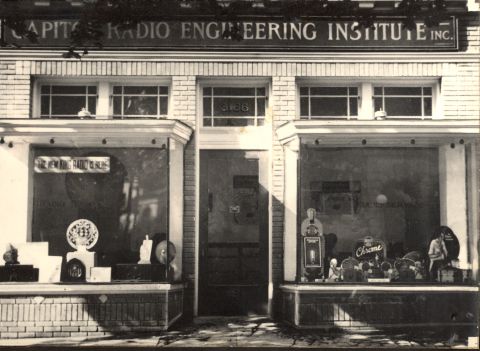
Capitol Radio Engineering Institute, 1935

Capitol Technological University, present day.