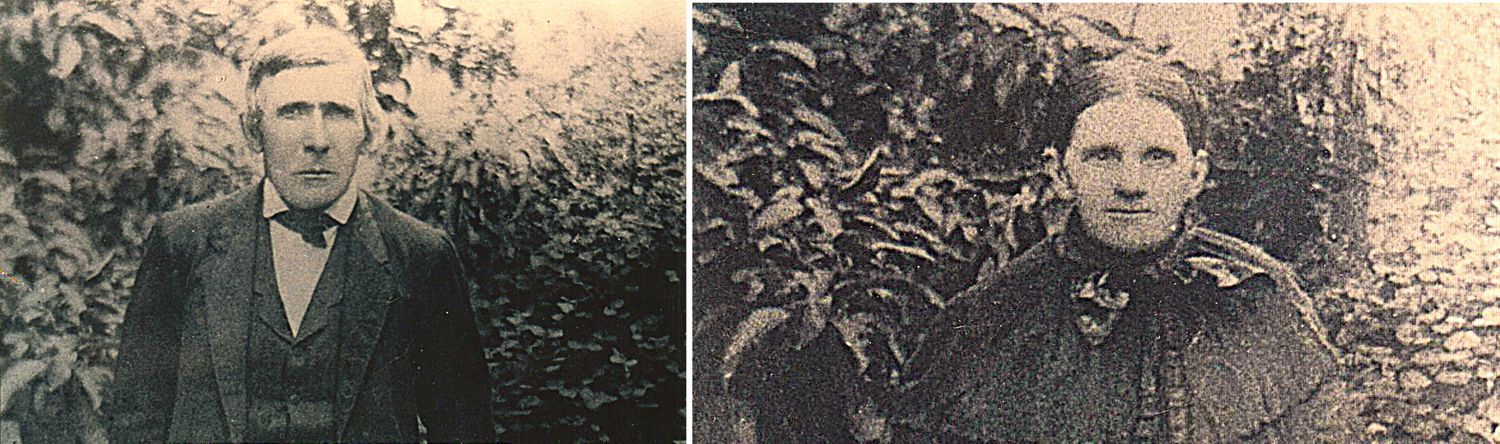
Georg Hohmann & Kunigunda Mueller Hohmann
40. Table of Contents Previous Next
10/13/26
Georg and Kunigunda
Both of my parents had jobs, so Mom dropped my sister, Anna, and me off at the world’s best daycare center, Grandma’s house, every morning on her way to work. Grandma and Grandpa told me stories of their younger days, sometimes repeating them, as older folks tend to do. As an older folk myself now, I am beginning to repeat myself. I don’t forget the events, just whom I told. My younger friends are usually patient with me, realizing I’m approaching my dotage. Sometimes they even request the retelling of the more lurid tales, but usually they gently remind me that I’ve told them something multiple times.
Once, I heard my grandparents talking about a woman named Kunigunda, I thought, Wow! What a cool name. I certainly had never met or heard of another Kunigunda. So, instead of being a fly on the wall, just soaking up their stories, I spoke up and asked, “Who was Kunigunda?” Grandpa told me that Kunigunda Mueller Hohmann was his grandmother, who had come from Germany to visit her friends in the United States and had been so frightened by her transatlantic crossing that she never returned to Germany. That’s about all he told me. It wasn’t until recently that I learned her amazing story.
Georg, the man named in the title of today’s yarn, added an ultimate ‘e’ to his given name after he became an American (but I think the original spelling is neat, so I’ll stick with that). He was my great-great grandfather, Kunigunda’s husband. He died at the age of ninety-six after falling from a stool he was standing on while trying to repair something. That’s all Grandpa had to say about him. I sure wish I had known to ask more questions.
But I was able to learn quite a bit more about them both, Here’s how.
I recently collected old photos from various members of my family to include in a digital archive. I scanned about four thousand items, some dating back to the 1870s. As I looked at the pictures, I wondered about the faces looking at me from the past and began trying to find out more about my forebearers. My mother’s cousin, Isabella, had researched the Hohmann family in the 1970s and sent a copy of her findings to Mom. Thank goodness, a copy of that detailed genealogy was in one of the boxes of photos. Isabella’s discoveries plus some internet searches enabled me to piece together the stories of my great-great grandparents. Please stick around for a few minutes, because I think you’ll find their stories interesting.
_______________________
I’m sure you’ve heard of the Irish potato famine that triggered a mass wave of immigration to America in the 1840s. But what I didn’t know until I started checking into my family history was that that it affected Germany nearly as badly. During the crisis, my ancestors in Weiperz, Hessen, hunkered down, waiting, and praying for better times. When it was finally over, Georg’s parents, Johann and Eva, and some Hohmann cousins, decided to emigrate. Johann sold his house to finance their passage and crossed the Atlantic with eighteen-year-old Georg, their other children, and their cousins, arriving in New York in 1847.
They traveled by steamboat and stagecoach to Wheeling, Virginia (now West Virginia), where the Hohmann men found jobs in glass factories and brickyards. When they had saved enough, they pooled their money and bought a hundred acres that straddled the border between Marshall and Wetzel counties, about thirty miles southeast of Wheeling. The Hohmanns cleared the land, built log cabins, and lived the American dream of becoming self-sufficient farmers. They and other German Catholic immigrants formed the tight-knit community known as St. Joseph’s Settlement. Their first church, built in 1855, was a log cabin.
_______________________
Kunigunda Mueller’s family must have been more well-off than the Hohmanns, as she was able to afford at least two transatlantic crossings to visit friends and relatives in the United States. Her first voyage must have been uneventful, as the only record of it is the passenger manifest of the ship she traveled on, preserved in the National Archives. I’ll tell you about her second crossing as soon as I let you know what was going on in the North Atlantic in 1854 and 1855.
The sea lanes were plagued by a record number of icebergs and ice fields during those years—so much so that the major shipping lines altered their transatlantic routes. Several close calls and collisions had already been reported by the time Kunigunda’s ship, The Admiral, left Bremen in late 1854. En route to Baltimore, the ship collided with a large iceberg. While it didn't sink, it became stranded on the berg. In the days before wireless communications, ships had only flares and flags to signal distress, so they just had to wait, hoping another ship would come along. That never happened, as the routes had been altered. Kunigunda, her fellow travelers, and the ship’s crew remained marooned for three months. The provisions that were meant to last only forty days dwindled until each passenger’s ration was one potato a day. As spring approached, the melting ice provided a ray of hope. At last, the crew was able to free the vessel and get her underway again. Kunigunda arrived in Baltimore in the spring of 1855. When she set foot on shore, she vowed never again to board a ship or even go near open water. She cancelled the planned return trip to her former home in Mittelkalbach, Hessen.
After about eight months of travel on sea and land, Kunigunda arrived at St. Joseph’s settlement, home of her former neighbors from Hessen, the Hohmanns. The story of Georg and Kunigunda’s
courtship is lost to history, but church records show that On June 27, 1855, they were the first couple to be married in the newly built St. Joseph’s church. They raised eight boys, one of whom was my great grandfather, Joseph. Kunigunda never looked back.
Tom Mindte
October 2026
Georg Hohmann & Kunigunda Mueller Hohmann
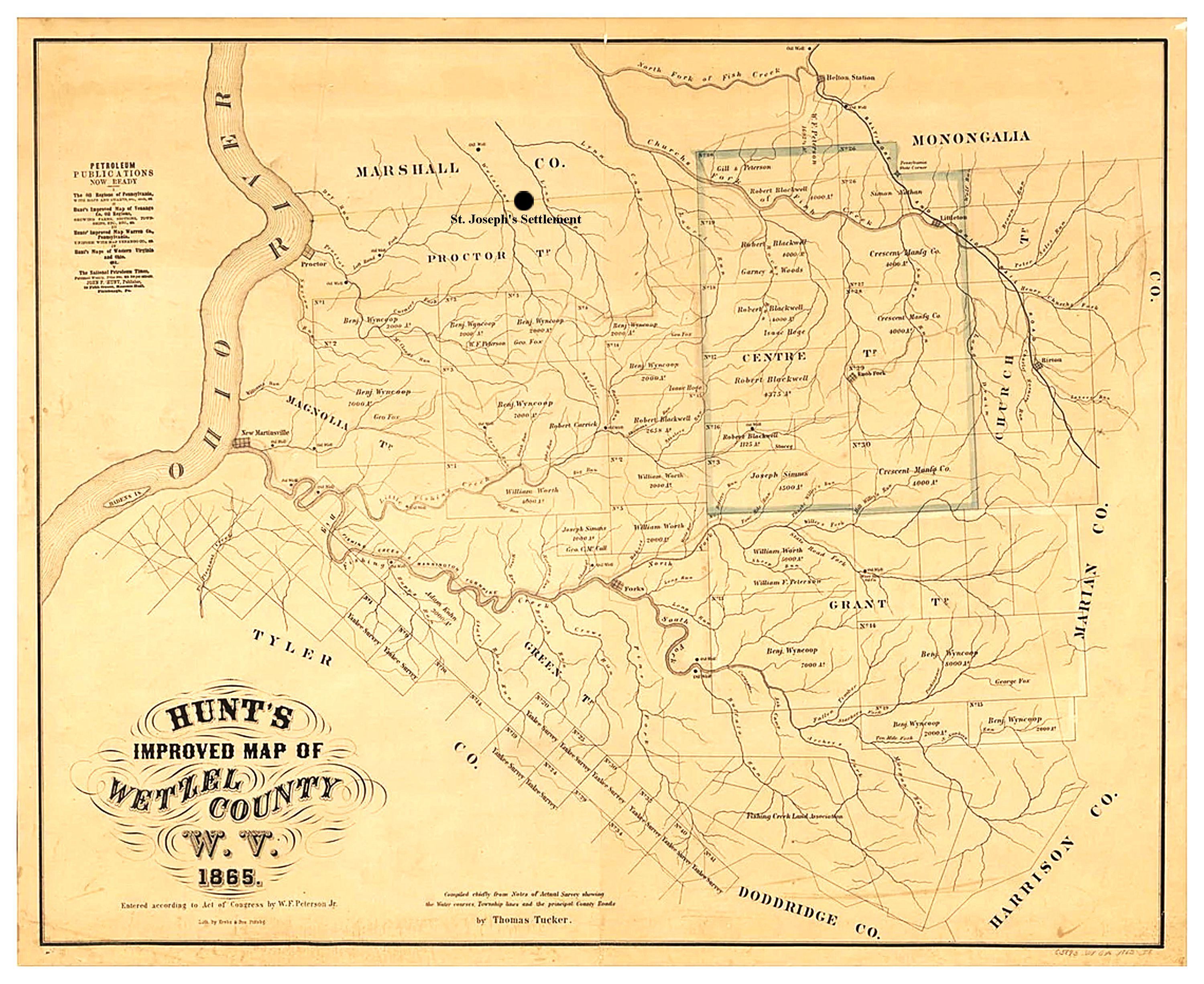
Location of St. Joseph’s Settlement