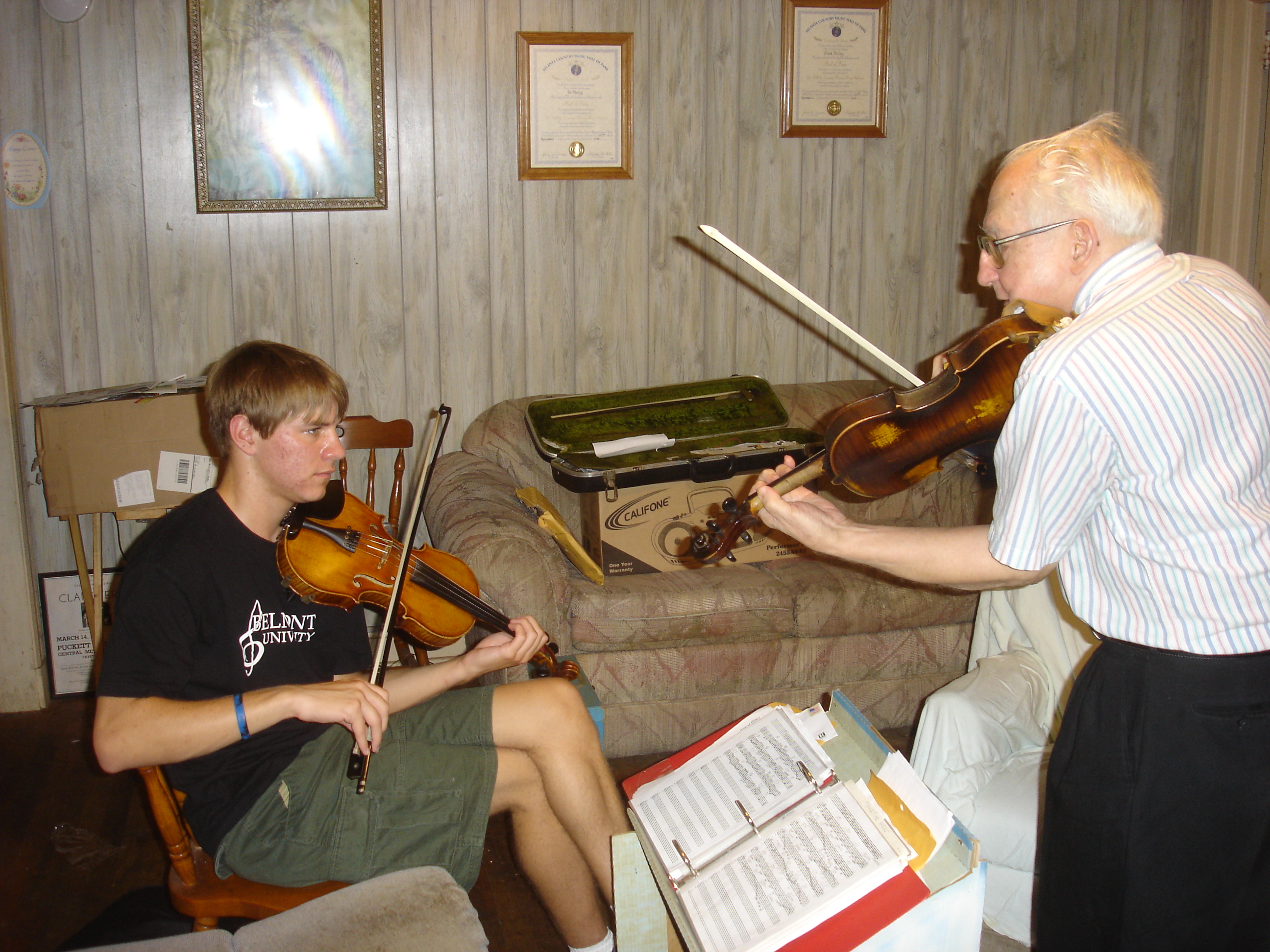
Casey and Frank
44. Table of Contents Previous Next
10/23/26
159 Georgia Fiddle Tunes in Three Days
Frank Maloy (1927-2020) lived music. Every hour of every day, even in his dreams, he was thinking about music, writing music, listening to music, or playing music. A constant companion, music was always going ‘round and ‘round in his head. At any given moment, Frank’s mental tape machine may have been playing a classical violin concerto, a jazz standard, a western song he had heard fifty years earlier in a Gene Autry film, a pop song, or even a television theme. At other times, melodies materialized in his mind from out of nowhere. Those sparks became his originals. Whether a musical memory or an original creation, Frank had the ability to write melodies down in standard music notation on homemade transcription sheets that were always handy. Besides being able to write down his musical thoughts, he could transcribe music from recordings or radio in real-time. As he was listening, he just wrote down the note heads, adding the stems and accidentals after the fact.
Frank’s compositions number in the thousands. With an ever-increasing catalog of tunes, choosing a unique name for each became a challenge. He usually named tunes after his friends or places. For example, he wrote one for me titled “Tom’s Patuxent River Waltz.” One of his compositions memorialized his mother’s music teacher. Its title was “Arty Missy Candy Fishy Georgia Yancy Barntown Williams Rag,” her real name, according to Frank
After naming a tune for his birthplace, Telfair County Georgia, Frank decided to write and name a tune for each of the 159 counties in his home state, and to churn them out at the rate of one per day. Since he was busy with other projects too, he found a way to combine his morning composition with his morning constitutional. I’m not talking about a walk in the park, but the activity that occurs each morning in the bathroom. Each morning, Frank sat on his throne with his mandolin and transcription paper on a make-shift table made from a board covering the bathroom sink, composing a tune for a county in Georgia. With no embarrassment, Frank explained his method to bandmates, friends, and casual acquaintances. As word of his ingenuity spread, the local television station in his adopted hometown of Tifton sent an investigative reporter to Frank’s house. The resulting news segment showed Frank, fully clothed of course, on the throne with the seat down, music paper and pencil in hand.
When the composing was complete, Frank wanted to publish the tunes in a book, along with recordings of all 159 on CD. He made it clear that he didn’t want to be the performer but would seek out another fiddler, accomplished in both technique and sightreading, who could play through the book. I agreed to do the publishing and recording as soon as we found the right musician
______________________________________________________
Before I tell you how the 159 tunes came to be recorded, I’ll step back and recount Frank’s story of how he got his fiddle bow rehaired during the depression when there was little money for such things. At that time in Milan, Georgia, a wagon peddler who sold general merchandise came through town periodically. Frank asked the hawker to sell him hair clippings from the horse’s tail for the bow. Frank and his mother were able to install the new hairs after being advised by his music teacher.
__________________________________________
At a music convention in Nashville, I heard a fiddler who sounded like a cross between Stephane Grappelli and Benny Thomasson. As I rounded a corner and saw who was playing, I was surprised to see a teenager who played like an old master. I introduced myself and let him know that I was a record producer. That fiddler, Casey Driscoll, gave me his contact information and allowed me to record him and his accompanist doing a couple of tunes. On my next trip to Georgia, I played those field recordings for Frank Maloy, who said, “You ought to record that boy, he’s fantastic.” So, during Casey’s spring break from high school, he and his friend, Jon Grisham, came to my studio and recorded an album of Texas fiddle tunes.
When Casey’s album was released, I sent a copy to Frank. After he heard the album, he asked if I could bring Casey to meet him on my next trip to Georgia. Coincidentally, after Casey’s mom heard an album by Frank and his brother, Joe, she told him that he ought to visit Frank. So, it seemed like Frank and Casey were destined to meet.
At Frank’s house, after some preliminary jazz standards, Frank brought out the box containing the manuscripts of the Georgia fiddle tunes. Casey read through them, one after another, expertly, never having seen any of them before. Frank, who had already auditioned several candidates, said “That’s our boy!” We explained the proposed project to Casey, who enthusiastically agreed to record the tunes. Jon Grisham was brought in once more as Casey’s guitarist.
Casey and Jon recorded two takes each of all 159 tunes over a three-day period – an incredible and most likely unprecedented feat. When the recording was complete, I asked the boys if they wanted to go sightseeing in Washington. They said they had already seen the monuments on a school field trip, but they really wanted to see the staircase in Georgetown where a scene from “The Exorcist” was filmed. We took in that sight and they returned to Nashville the next day.
Patuxent Music released the book, “159 Original Georgia Fiddle Tunes,” and Casey Driscoll’s renditions of the tunes in 2010. I’ll tell you about more of my musical adventures with Frank and Casey in future doodles.
Tom Mindte
October 2026
Casey and Frank
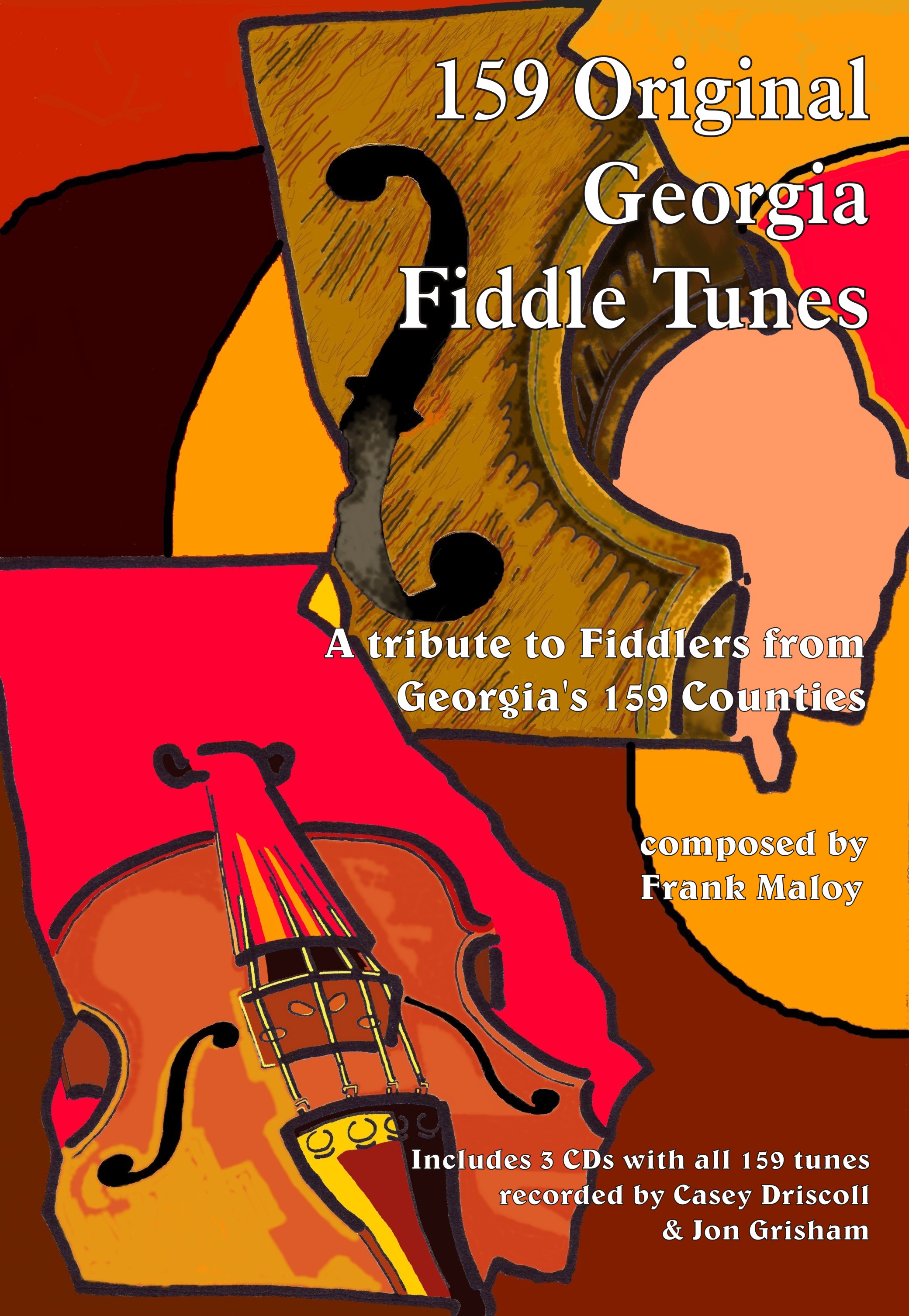
The book cover
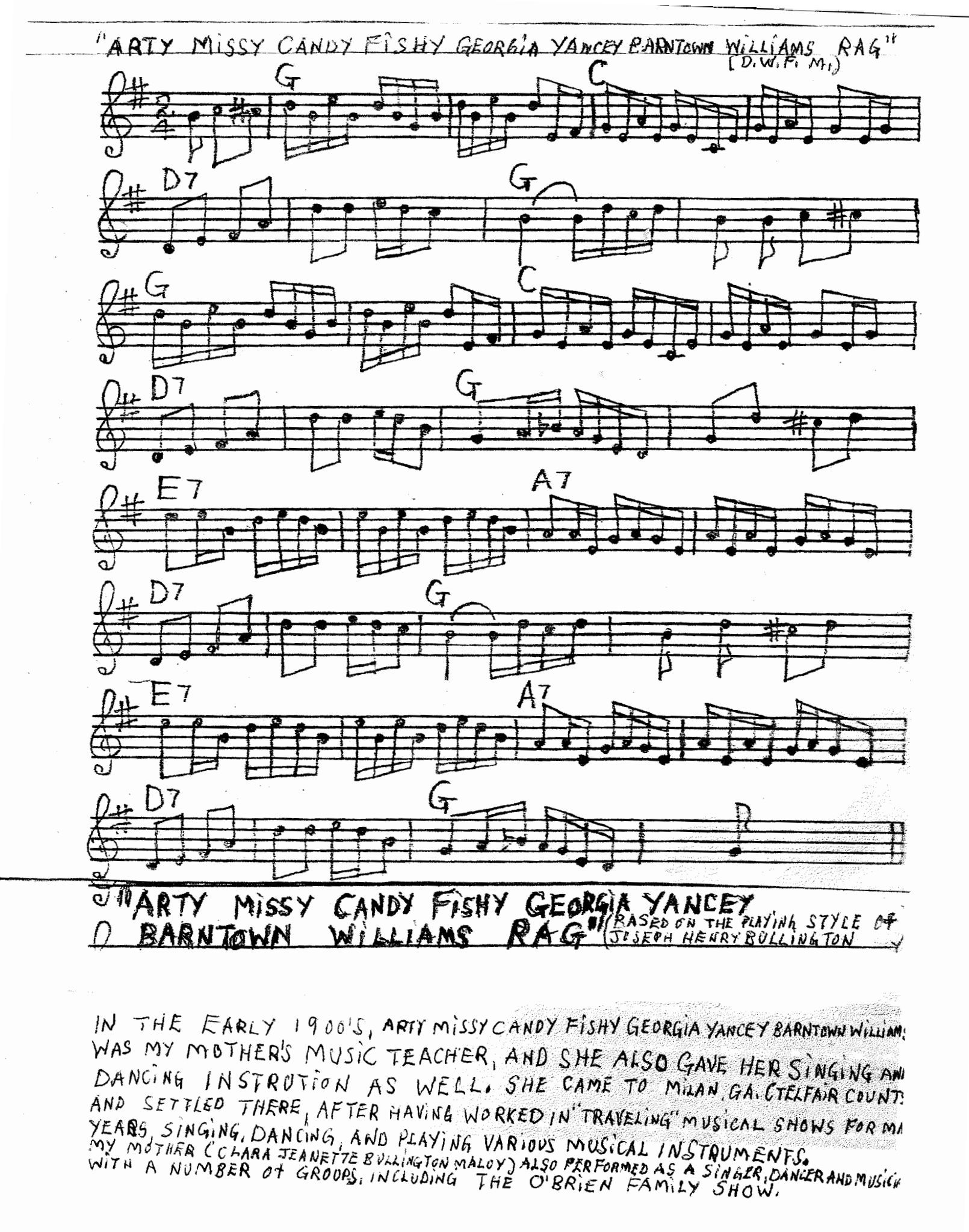
Frank’s manuscript of “Arty Missy Candy Fishy Georgia Yancy Barntown Williams Rag”
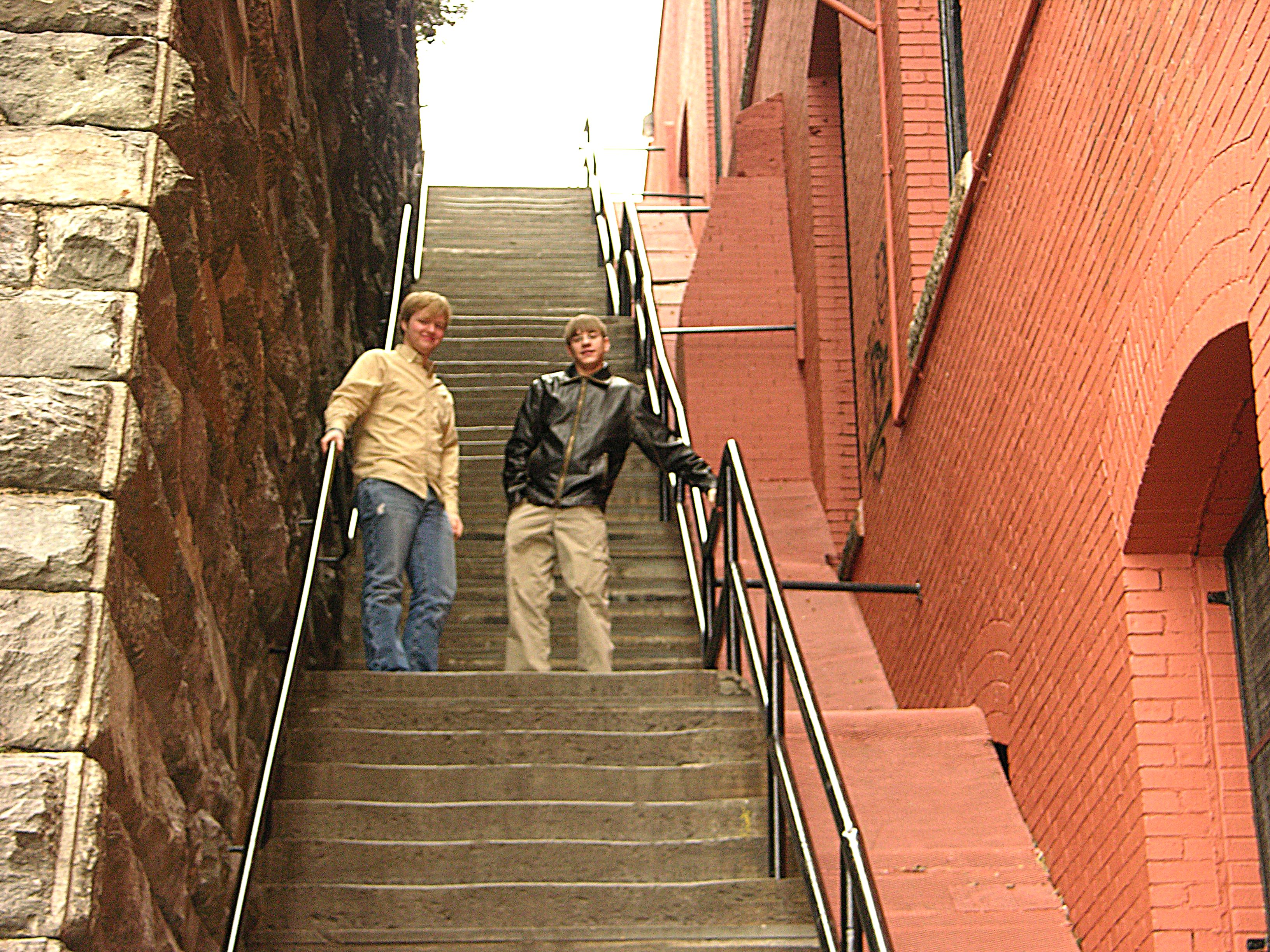
Jon & Casey on “The Exorcist” stairs