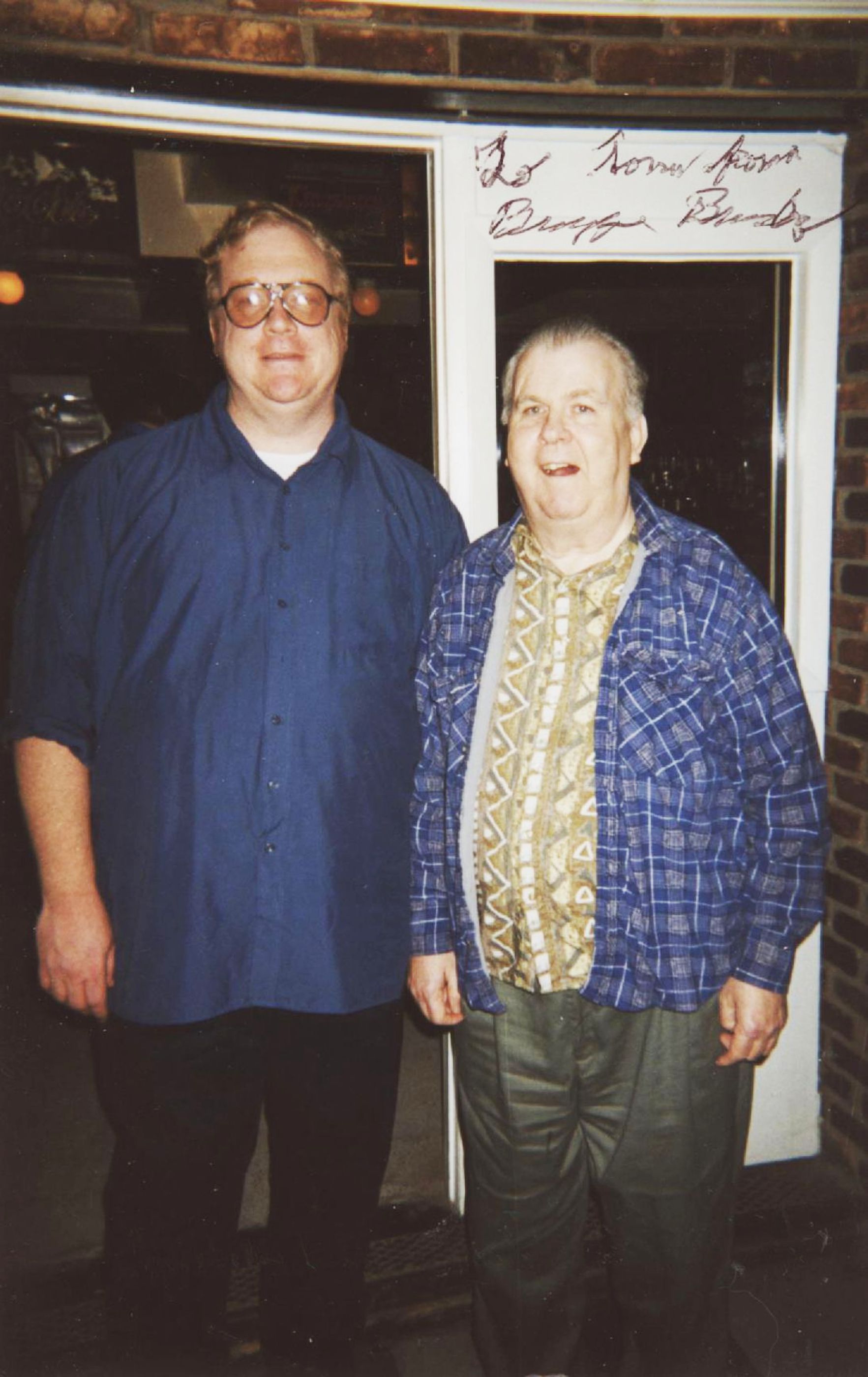
Tom & Buzz an the Friendly Inn, 2001
22. Table of Contents Previous Next
9/8/2-26
“How I Met Buzz Busby”
The following is an excerpt from the preface of Buzz Busby: Father of Washington, DC, Bluegrass by Kip Lornell & Tom Mindte ©2026, University of Illinois Press.
Used by permission of the publisher, who would like me to mention that the book is available at https://www.press.uillinois.edu/
_____________________________________________________________________
“Just Me and the Jukebox,” Buzz Busby’s most well-known song, could often be heard playing on the family hi-fi in our Rockville, Maryland, home in 1965, the year it was rereleased by Rebel Records on a bargain-priced four LP set. The omnipresence of bluegrass and country music in our house was my father’s most important contribution to my early music education. Daddy not only provided the records but took me to many live performances around the Washington DC area, most memorably, shows by George Jones and Lester Flatt & Earl Scruggs.
I was drawn to the Busby songs on that set, first because of his high and clear voice, and secondly by his lightning-fast mandolin playing. Daddy had recently acquired a mandolin as a part of a barter-for-work deal, and I was taking my first fledgling steps at learning that instrument. When Daddy told me that he had once frequented Buzz’s performances at the Pine Tavern near the bus station in Washington, DC, I felt as though I had a connection to Buzz, a single degree of separation!
Fifteen years later, I was shocked to discover that Busby, whom I had assumed to be retired or long dead, was about to perform at the Friendly Inn in Ellicott City, Maryland, near Baltimore. I immediately called to make a reservation and was told that it wasn’t necessary; to just “come on.” I arrived an hour early, expecting to meet hundreds of bluegrass fans going there to see Buzz Busby, the heroic, almost mythical star of my youth. Instead, there were about five or six patrons drinking beer at the bar. Unsure that I was in the right place, I asked and was told that yes, Buzz would be playing that night. When the band finally began playing, I was dismayed to see my mandolin hero playing an electric guitar and singing country music standards.
During the intermission, I asked Buzz about the mandolin. He told me that the customers of that bar liked “straight country music,” but since I had asked about it, he would bring the mandolin in from his car for the next set. He retrieved the mandolin and upon finding out that I played, handed it to me and said, “Go up there and do the next set with the boys.” The band was not very happy about that, but they tolerated me while Busby sat at the bar and drank beer. I never heard Buzz Busby play the mandolin at our first meeting.
My next attempt to experience the mandolin playing that I craved occurred a month or two later, still in 1980, at The Gallery, another beer-joint, not far from our home in Rockville. According to Blueprint magazine, a short-lived DC area bluegrass music monthly, Busby was to perform with Al Jones and Frank Necessary. I was certain that that show was going to be nothing but traditional bluegrass music, as I was familiar with Jones and Necessary because their music was being played on radio station WAMU-FM, Washington’s premier bluegrass station, located at American University.
Again, I arrived early, only to find that the club hadn’t opened yet. Determined to be the first to get in, I stood by the door for an hour. About four or five people showed up before the doors opened. When the show finally began, Buzz, Al, Frank, and bassist Doug Ward put on one of the best bluegrass shows I had ever seen. Their high lonesome singing and instrumental pyrotechnics was all that I had hoped for. After the show, I spoke to Buzz, who amazingly, remembered me from the Friendly Inn.
So, in 1980, Buzz Busby still had it. Despite all of his trials, tribulations, and addictions that you will read about in the pages that follow, he could put on a great show. Though his singing voice wasn’t what it once was, he was playing as great as ever and he exhibited his magical stage-presence and sense of humor that had been captivating audiences since the early 1950s.
_____________________________________________________________________
That’s the end of the excerpt from the book, but I’d like to let you know that Buzz became one of my mandolin mentors and I eventually ended up playing bass in his band, the Bayou Boys, for six years.
During one of my visits to Busby’s apartment, he told me that he had recorded about sixty hour-long cassette tapes which had started out as an audio diary but had morphed into an autobiography. His stated purpose for making the tapes was to provide information to a potential biographer.
Those tapes, plus about thirty interviews with his bandmates, family members, and other important people in Buzz’s life, inform the biography. If you should decide to order the book, I believe you’ll find it a good read.
Tom Mindte
Tom & Buzz an the Friendly Inn, 2001

The book cover.