Ettore Buzzini reviews
CD-394

Ettore Buzzini
Blue Blue Blue
info buy CD
download
Blue Blue Blue
Dear Old Dixie
Don’t Love Me
All My Loving
Kentucky Waltz
How Mountain Girls Can Love / Baby Blue
You Don’t Know Me
Flowers
Happy
Out in the Marshy Waters
Breathe On Me
Banjo Sonata
The key to becoming a complete musician is listening. Not only listening to what fellow musicians are doing during performances but listening to a wide variety of musical genres and styles, especially throughout one’s formative years. Ettore Buzzini certainly listens. Ralph Stanley, Franz Liszt, The Beatles, Earl Scruggs, Badfinger, Eddy Arnold, Gustav Mahler, Pharrell, Williams, Reno & Smiley, and many, many, more predecessors from diverse genres and eras all helped to shape Ettore’s muse and their spiritual presence can be felt on this album. Yes, he reinterprets some of their work, but one of his many talents is to combine their influences to create new music. His Swiss-American-Appalachian upbringing is thrown into the melting pot too and you are about to listen to the result.
First, I’ll briefly describe Ettore’s original compositions herein:
The title track, “Blue Blue Blue,” a dark and mournful story of lost love, features tenor singing by Danny Paisley, who has been honored as the International Bluegrass Music Association’s vocalist of the year several times. Their vocal blend brings on the chills.
“Don’t Love Me” is Buzzini-composed bluegrass melody and his own translation of “Liebst du um Schönheit” by Friedrich Rückert (1788 – 1866), First set to music by Gustav Mahler (1860 – 1911). The song, which extols the virtue of pure love over physical beauty, youth, and riches, is a perfect fit for bluegrass.
“Flowers” extols the beauty of nature, both floral and that of a lovely woman. The splendor of Patrick McAvinue twin fiddles and Ettore’s banjo solo make “Flowers” a true work of art.
Before television and movies, stories of tragedy, disaster, and historical events were told in song. Many of these ballads were brought to America by the ancestors of immigrants to Appalachia, who rewrote them to fit their new surroundings. The murder-ballad tradition remains to this day – new stories are told; new songs are written. “Out in the Marshy Waters” is Ettore’s contribution to that genre.
“Breathe on Me” is a nineteenth century hymn with a new melody. Ettore’s four-part harmony vocal arrangement with counterpoint calls to mind the shaped note singing of that era.
The final selection on the album, Buzzini’s “Banjo Sonata,” is the creation of a gifted musician who listens to all of the above music and combines those ideas and his own magnum opus, at least for now.
--------------------------
Technique is as important as listening for the complete musician. Ettore’s mastery of the banjo and vocal styles can be heard throughout this album – on his own compositions, of course, but also on renditions of numbers made famous by his predecessors. Many of these old gems have been given life via his arrangements, while respect for tradition is maintained throughout.
The Scruggs classic, “Dear Old Dixie,” gets a new minor key section and a soulful fiddle part by Ettore’s contemporary Willie Marschner.
“All My Loving,” from Meet the Beatles, their second album, released in 1963, features exquisite harmony vocals by Will Hart.
Michael Cleveland played twin diddles on Bill Monroe’s “Kentucky Waltz.” Coproducer Tom Mindte provided a Monroesque mandolin solo.
Pairing The Stanly Brothers hit “How Mountain Girls Can Love” with “Baby Blue” by Badfinger? Yes, it works. “Mountain Girls’ builds you up to the brink and “Baby Blue” brings you back to a mellow state of mind.
“You Don’t Know Me” written by one of the most creative and prolific songwriters, Cindy Walker, is the epitome of teen angst sagas. “Afraid and shy, I let my chance go by,” is something most of us have experienced in our youth.
“Happy,” composed by Pharrell Williams, is a grammy award winning song from the film, Despicable Me 2, You can’t help smiling and clapping along with this uplifting song.
----------------------
Coproducers Buzzini and Mindte assembled a cast of phenomenal musicians to make this album a reality. Their expertise and Ettore’s creativity and technique, join up to make Blue Blue Blue a winner.
Thanks for listening.
Tom Mindte

Eddie Ray Buzzini - banjo, guitar, vocals
Danny Knicely – mandolin, guitar
Marshall Wilborn – bass
Patrick McAvinue – fiddle
Willie Marschner – fiddle
Mason Via – vocals
Tom Mindte – vocals
Ida Rose Buzzini – vocals
Lyla Cherry - vocals
Lake Carver – vocals
Tae Childress – guitar
John Powell - vocals
Kyser George – guitar
Luke Morris – mandolin
David George – bass
Southbound 77 Bluegrass - vocals, guitar
Ragnarok
Farewell Blues
Bringin’ in the Georgia Mail
I’ll Try Not to Care
When You and I Were Young, Maggie
Preachin’ Prayin’ Singin’
Cash Don’t Sleep
New Camptown Races
You’re No Good
Old Flame
Sunny Ray
Daniel Prayed (feat. Southbound 77 Bluegrass)
“I plan to carry this music forward to the twenty-second century.”
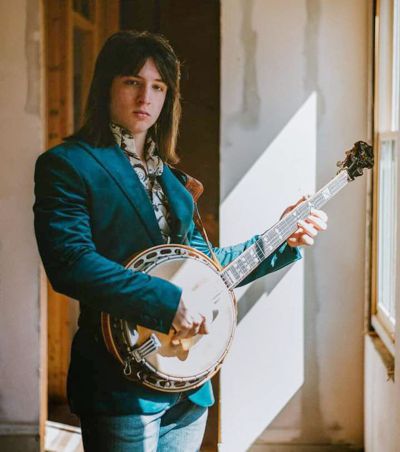
Eddie Ray Buzzini’s bold declaration is not so far-fetched, as he was born in 2007 and may well still be picking in 2101. A second of Eddie Ray’s aspirations is to convince his contemporaries that bluegrass and particularly banjo music is cool, up-to-date, and should be considered legit. Confirming his commitment to both intentions, the music on Eddie Ray’s solo debut album covers well over a century of compositions. Ranging from “When You and I Were Young, Maggie,” composed in 1864, to several new songs written by Eddie Ray, the disc offers a wide array of American music in the bluegrass style.
Eddie Ray, whose given name is Ettore, lives in a multi-lingual household in Mooresville, North Carolina where his Swiss-Italian father and East-Tennessee born mother offer him a vibrant mix of European and Appalachian culture. He plays his grandfather’s banjo and listens to Flatt & Scruggs and Reno & Smiley as well as many of the contemporary bands that are playing today. Eddie Ray’s musical tastes are not limited to bluegrass. Country classics, Latin Jazz, and the guitar of Eddie Van Halen are all on his listening and playing agenda.
The three original compositions on this project prove that Eddie Ray is already on a trajectory to become an inventor as well as conveyor of widely varying musical styles. His “Ragnarok,” composed at age eleven, is a saga of the battle that brought an end to the great Norse gods, including Odin and Thor. “Cash Don’t Sleep” is the emotive tale of an undocumented immigrant who runs into some serious difficulties trying to get to his family in North Carolina. “I’ll Try Not to Care,” cowritten with Mason Via and producer Tom Mindte, focuses on classic “boy meets girl” drama – their parting leaving the boy with a bad case of teen angst.
Joining Eddie Ray on this project instrumentally are Danny Knicely, Marshall Wilborn, Patrick McAvinue, and Willie Marschner. Mason Via and Tom Mindte are featured on several numbers singing harmony vocals.
As a special treat, Southbound 77, a bluegrass band of young pickers that Eddie Ray regularly performs with, gathers for the final offering here.
Sit back, relax, and enjoy this presentation of Eddie Ray’s wide-ranging musical gifts - his first – and it won’t be the last!
Tom Mindte
Patuxent Music