46. Table of Contents Previous Next
10/28/26
Rough Passage
First, let me tell you about how I became a Chesapeake Bay captain. It wasn’t as though I was commanding a vessel like the Queen Mary or anything like that. My craft was several orders of magnitude smaller. But I did rack up an equal number of departures and arrivals, unlike the captain of the Titanic, who was one short in the arrival department. Nor was I as renowned as Captain Kirk of the Starship Enterprise, but as far as I can tell, I’m non-fictional.
My parents loved the Bay and owned a series of small boats when I was a teenager. But as their business grew, their free time diminished, so they had to give up boating. Whenever Daddy’s hankering for salt air got the best of him, he headed to the Bay for a fishing excursion on a charter boat. Sometimes he invited me to go along, but I was always playing music somewhere and could never accompany him.
When I heard that WAMU radio was sponsoring a bluegrass cruise, I saw it as the perfect opportunity to hang out with the old man and experience the Chesapeake once more. The ship left Baltimore Harbor at sunset and cruised along with the bluegrass music blaring. Daddy and I sat and watched the band, Windy Ridge, play for a while, then headed for the bow to catch the sights. After some chit-chat and exchanging funny stories, a light bulb went off in my head—an absolutely brilliant idea, if I may say so myself. I said, “Dad, let’s you and I buy a boat together and get back on the Bay.” I got the most common and most annoying reply a parent can give a child (I was actually twenty-three then, but still a child to him). He said, “We’ll see.” That ended that. No boat. Shucks—or so I thought.
About a week later, Daddy threw a page from the classifieds in the Post in my lap. One of the ads was circled in red. A thirty-six-foot deadrise cruiser with twin screws was for sale in Virginia Beach. The price was affordable, and the owner would self-finance it. I was shocked. It was the first time in the history of the world that a “we’ll see” turned into a “yes.” When I urged Daddy to call the number in the ad, I was astonished to learn he had already called and made an appointment to test-run the boat!
We bought her, of course.
Her name was the Carmen. She was beautiful. Built at Curtis Bay, Baltimore, by Watson Lewis in 1964, her hull planking and keel were of Philippine mahogany. She was powered by twin Chrysler 318-cubic-inch, fresh-water-cooled engines. This is the crucial part. Her net tonnage was nine tons, which, in nautical terms, is not a measure of weight but of volume. Nine net tons represents 900 cubic feet of volume. Vessels of more than five net tons can be documented by the United States Coast Guard rather than registered solely through a state agency. Since the previous owner had documented the Carmen, the paperwork called for a captain to be designated upon transfer of ownership. Daddy didn’t want anything to do with the paperwork, so he said to me, “You be the captain, but don’t let it go to your head.” I pretty much didn’t, but I’ll admit to signing my name as Capt. Tom Mindte on a credit card receipt when I took folks for a cruise to the Crab Claw restaurant in St. Michaels, because they were watching me sign it.
______________________
In the early 1980s, the Folklore Society of Greater Washington sponsored an open mic at Gallagher’s Pub in the Cleveland Park neighborhood of D.C. Many similar showcases were places for neophytes to gain experience in front of audiences. That wasn’t the case with Gallagher’s. Yes, newcomers were there, but some well-known professionals performed there, too, to try out their new material and socialize with other musicians. One of those pros was Neil Harpe, a bluesman who learned directly from Mississippi John Hurt, Elizabeth Cotten, and others. Neil is also a visual artist. One of his many specialties is painting scenes of Chesapeake skipjacks, the sailing vessels used to harvest oysters. One night at Gallagher’s, while Neil and I were discussing our interests outside of music, I learned about his art, and he learned about my Carmen. After a few pints, we agreed to run the Carmen to Seven Foot Knoll Light two days hence. The lighthouse, located at the mouth of the Patapsco River, was about to be retired and moved to Baltimore’s Inner Harbor. Neil wanted to take photographs of the historic structure, which had stood there since 1855, before its relocation. His plan was to paint a scene that included the famous lighthouse and a skipjack.
As the Carmen cruised out of the West River with me, Captain Tom (I love saying that), at the wheel, we noticed a few whitecaps, nothing serious. The wind was out of the south, so we would have a slight following sea on the way up. As we went under the Bay Bridge, the seas grew noticeably rougher, with about three-foot crests. After Neil got his pictures, I turned her around and headed south. We were heading into it. The seas had now reached five feet, and the wind was increasing. I had run her in six-foot seas once before, and had I been alone or with Daddy, I might have continued the trip back. But the waves were breaking over the wheelhouse, and we were soaked. Neil had brought at least a thousand dollars’ worth of photographic gear, and we were really bouncing around as we headed right into the wind. So I decided to abort the mission. I brought her about and headed up the Patapsco. I took her into a marina and tied her up at the gas dock. That dock was too exposed to the weather to leave her there, so I sent Neil to find the dockmaster, who assigned us a slip. Once the Carmen was tied up and safe, we went into the marina’s restaurant and found that, miraculously, they had Guinness on tap.
For the second time in my life, I had to call my father to come to the rescue. The first time had been when my cousin and I hopped a train that carried us miles from home. Daddy said, “This is getting to be a habit with you.” I thought, but didn’t say: ‘C’mon, that was when I was fourteen.’
He thought I was wasting his time and that the Carmen could have handled the weather, but he came and picked us up. Once Daddy found out who my passenger was, everything was all right. Daddy and Neil talked Chesapeake all the way home.
The next day, my friend, Jim Pinkston, drove me to retrieve the Carmen and we ran her home in the dead calm.
Photos:
1. Craighill Channel Lower Range Lighthouse, located about a mile away from the Seven Foot Knoll Lighthouse.
2. Me and Daddy in the wheelhouse
3. The Carmen at the boatyard, 1964
4. The Carmen in her slip, 1980s
5. The finished painting, hanging on my wall.
Tom Mindte
October 2026
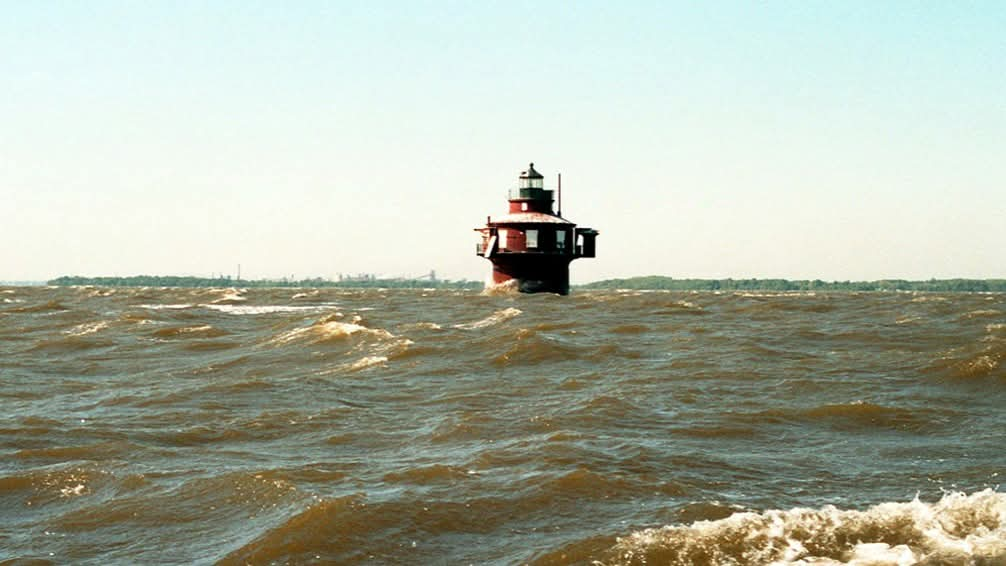
Craighill Channel Lower Range Lighthouse, located about a mile away from the Seven Foot Knoll Lighthouse.
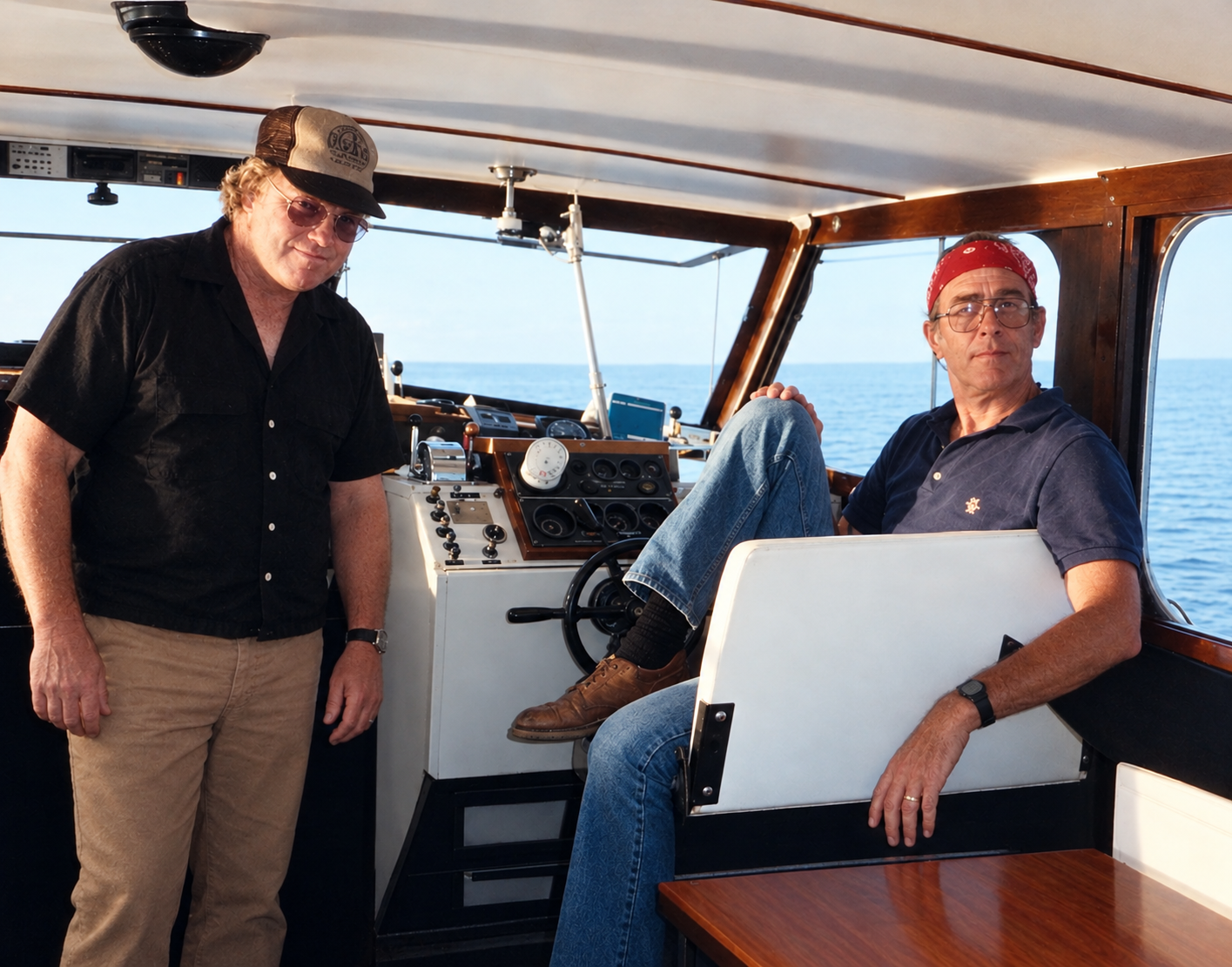
Me and Daddy in the wheelhouse
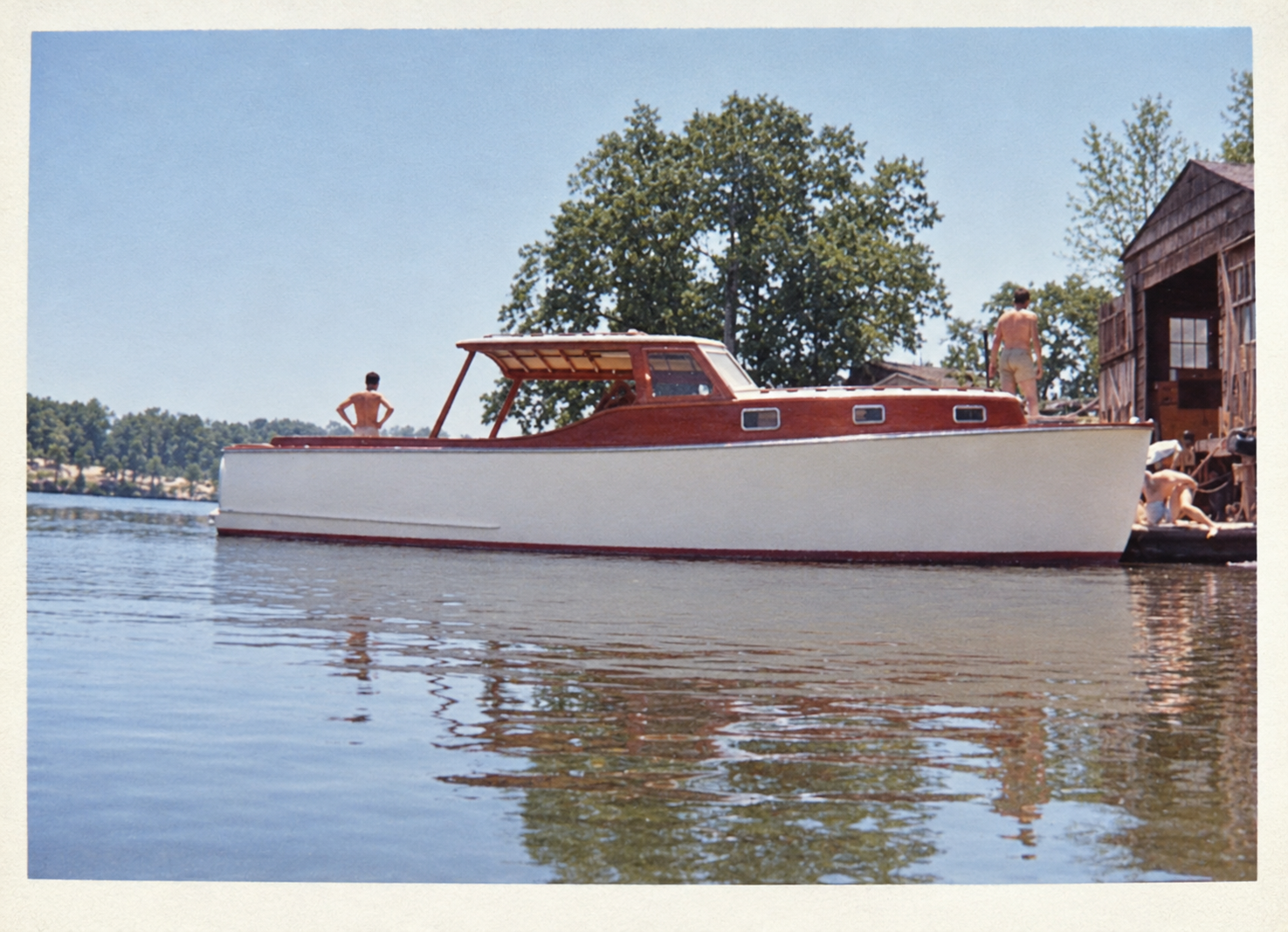
The Carmen at the boatyard, 1964
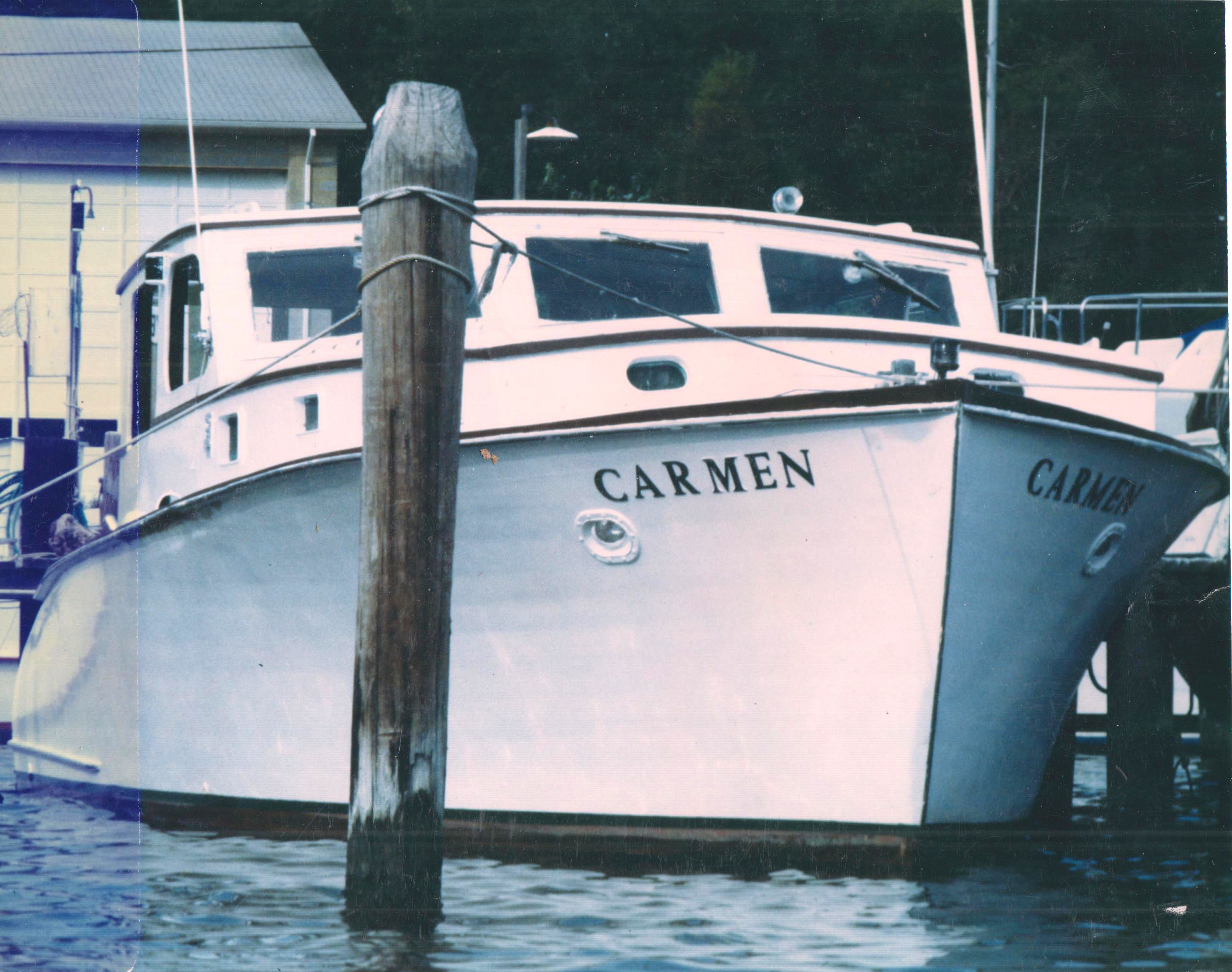
The Carmen in her slip, 1980s
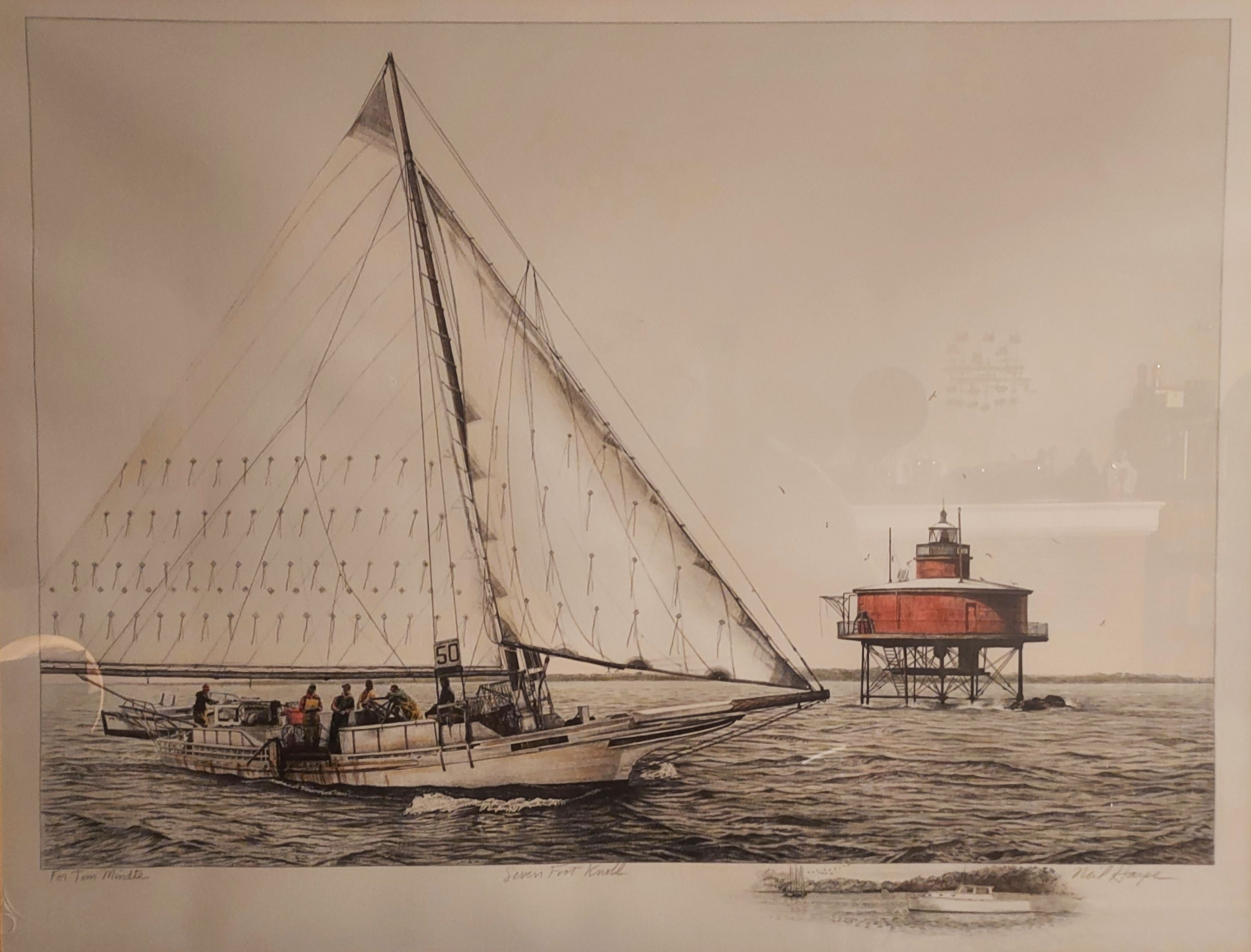
The finished painting, hanging on my wall.